
How Much Information Do Architects Owe the Public?
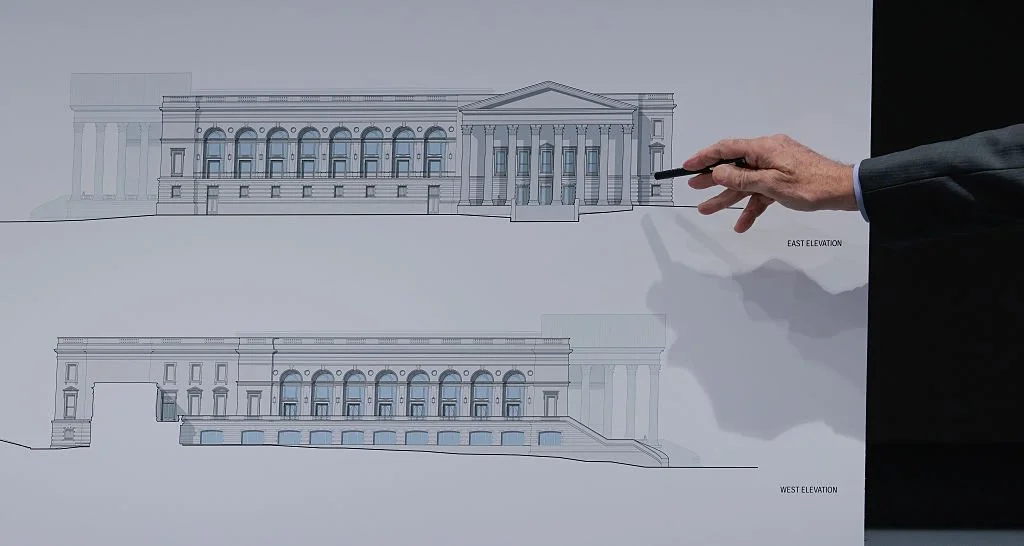
When the new White House ballroom images were published recently, I decided to learn about the firms that would take on such a controversial project. My goal was to get away from the histrionic narratives in the media and the questionable justifications offered by the executive branch, and presumably read a more nuanced description of the project’s goals.
What I found was a bit odd. After a little digging, I learned that until early 2025, the website of McCrery Architects, the original commissioned firm, included the typical things found on most firm websites: a description of services, bios of team members, notable projects, accolades, etc. Around April, the site became a landing page with a slide show—renderings of the ballroom front and center, a few photos of other completed projects—and nothing else. This almost complete redaction of anything useful was baffling until I realized it was right around the time that the firm received the ballroom commission. Was this the reason for the pullback? My next step was to visit the website of the successor firm, Shalom Baranes Associates. Although it’s pretty robust, including several federal and civic projects, it doesn’t mention the White House project at all.
What is an architect’s duty to the public? My experience has been that architecture has always had a highly regarded profile without most people fully understanding what we do. Our mandate includes initiating a discourse where outreach and active listening to people we may disagree with is required. We’re not elected to represent any particular social or political point of view, but it’s our role to consider a wide range of opinions and even stereotypes when designing. Our process combines technical skills with creativity, budgeting, redirection, acceptance, and persuasion to create something transformative. We seek a unified truth, something that elevates the human experience. Collaboration is required by all constituents; whether one agrees or disagrees with the end product becomes a matter of perspective: Is it good? More important, did the community feel heard?
Regrettably, the architects working on the White House ballroom appear to be avoiding any attempt to present a cohesive narrative on why it should be designed and built to replicate a Greek temple. The president has demanded a return to a classical aesthetic, evoking the wishes of our founding fathers (free white men), who sought to portray the democratic values of Ancient Greece (free white men in togas) as they hammered out an inchoate form of government that is still trying to find its footing. What no one at the White House is willing to openly acknowledge is that, despite the implied moral authority classical architecture has conveyed over the centuries—an argument either of the firms could have offered in support of the design—the building style chosen to represent our nascent democracy actually reflected by default the preferences of a ruling class that did not regard slavery, untethered expansionism, or the brutal repression of Native Americans as social injustices warranting concern.
In the U.S., where fracturing social norms has literally become a blood sport, the highest-profile government project deserves some sort of effort toward justification and community support. Is constructing a building that will house events that usually take place in tents on the White House lawn a good idea? Probably, but in this case size, context, and history also matter, and as much as the president would like you to think he owns the property, he doesn’t. We do. As he literally bulldozes his way forward, the architects are staying silent. Every firm can pursue its passion while paying the bills, and is certainly not required to advertise. However, we don’t have an implicit right to step away from an effective discourse. Retreating from that sows distrust, even when it appears to be more benign in nature.
(For other reasons, I recently visited the website of Sanaa, the Pritzker Prize–winning firm. As with McCrery Architects, there isn’t much to learn. I decided to click on one of the emails on the otherwise blank landing page and request a portfolio. Sanaa responded with a reciprocal query about my purpose, which I answered in detail. Despite a couple of reminders from me, the firm went silent, as McCrery and SBA have been from the beginning. With little apparent interest in sharing points of view when designing in the public eye, doesn’t this reinforce the old stereotype of architecture being an ivory tower profession?)
Fortunately, there are many examples of firms who openly embrace and share their civic responsibility. One of them is the nonprofit firm Troy Architecture Practice (TAP), in Troy, New York, home of my alma mater. Elizabeth Rodriguez, a former classmate and friend, has worked there since we graduated. After she told me recently about their nonprofit status, I was curious enough to visit TAP’s website. There are no highbrow projects or thesis-level proclamations, but there is a great narrative about what TAP has been doing since the 1960s to support its community, particularly the disadvantaged and low-income. The firm presents how it engages with clients; shares details of the placemaking process; describes in refreshingly plain language the arcane aspects of working on a project; links to resources; advertises living quarters in buildings they’ve designed and helped develop; and includes a historical timeline from TAP’s inception. Architects should take note of this approach, because we bring value to any conversation if our intentions to the community are clear.
Navigating various constituencies is exhausting, but when officials in charge desire symbols of oppression while demonstrating ineffectiveness and incompetence, they effectively pull the plug on a robust and safe public arena for debate. The result is a critically impoverished ability to deliberate together. For someone riding the crest of populist rhetoric, the president is essentially turning his back on his political base and offering the country his middle finger: “Trust me to do the right thing, because I certainly don’t need to hear what you think.” He demands that his columns and architraves project power and remain beyond reproach, while unarmed civilians protesting in our streets are murdered by masked men carrying out his orders. When public spaces become sites of sanctioned state violence rather than democratic assembly, that’s not just a political problem—it’s an architectural one. It is a corruption of what the built public realm is meant to be for.
If we reach out and engage with a social purpose as TAP has done, we convey cohesiveness and professional maturity to our community. While architects rightly seek clients that are mission-compatible, rest assured that every government organization, commercial interest, community group, nonprofit, etc., in a project’s sphere of influence has its antagonists. For our efforts to be successful, we should desire to explain our point of view and connect with those who we disagree with; after all, there may be some common ground that is ripe for exploration. This might make us uncomfortable. If it does, then we’re probably learning something new.
David Briggs AIA LEED AP CPHD
Principal | Founding Partner
Loci Architecture PLLC
This essay originally appeared on Common Edge.